The combination of blogs and social media have transformed publishing and communication beyond recognition in the past 2-3 years. This excellent post by Rajesh Setty, an entrepreneur, author and speaker based in Silicon Valley, was originally featured by Jamie Turner on his excellent blog 60secondmarketer.com. It was republished there with Mr Setty’s permission.
The post is called “9 Ways People Respond to Your Online Content” and is now republished here, with Jamie’s kind permission …
Blogs and Twitter have almost eliminated any barrier to publishing. You have an idea and in a few minutes your thoughts can be online. Think about it – with every person thinking about more than 50,000 thoughts a day, producing online content can be simple.
Maybe. But simply churning out meaningless content does not guarantee that others will read what you write. Make this mistake and people will read what you write and write you off.
What’s the alternative?
Use your creativity to generate content that will inspire and transform the lives of the audience in a positive way. Remember that it costs time (and indirectly – money) for your audience to read what you write. And, they expect a good return for that investment.
You will know whether you are succeeding in influencing your audience in a positive way because the audience will tell you. No, maybe not directly but by the way they respond to your content.
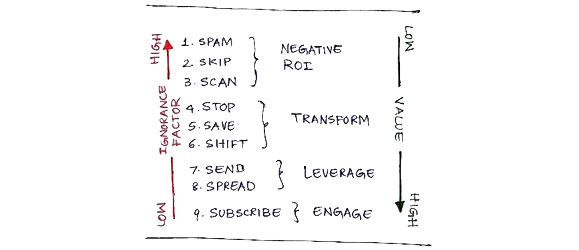
So, here are the nine ways your audience will respond to your online content:
- Spam: If your content does not provide a reasonable ROII (return-on-investment for an interaction) for the reader or is self-serving or simply useless, the reader will mark it as spam. Posting something that may be assessed, as “spam” is the fastest way to losing credibility.
- Skip: The reader makes an assessment that he or she won’t lose much by reading it. In this case, the reader has not written you off yet but if you consistently create content that is worth “skipping,” the reader might write you off.
- Scan: The reader thinks there are only a few parts that are of relevance and wants to get right to the core of the content and skip the rest.
- Stop: The reader is touched by the article and stops to think about the article, it’s relevance and what it means to him or her personally and professionally.
- Save: The content is so good that the reader might want to re-visit this multiple times.
- Shift: The article is transformational. The reader is so deeply affected (in a positive way) by the article that it shifts some of their values and beliefs. In other words, this piece of writing will transform the reader and make him or her grow.
- Send: The content is not only useful to the reader but also to one or more people in the reader’s network. The reader simply emails the article or a link to it to people that he or she cares.
- Spread: The reader finds the article fascinating enough to spread it to anyone and everyone via a blog, twitter or the social networks that he or she belongs.
- Subscribe: This is the ultimate expression of engagement and a vote of confidence that you will continue to provide great content. When the reader wants to continue listening to your thoughts, he or she will subscribe.
Finally, here are a few things to consider before you post your next online content:
1. Understand Your Audience
Unless you are writing something for your private consumption, your audience should be the center of the focus and not you. The more you know about your audience, the better you can connect with them. Think about:
- Who is your audience?
- Why are they reading what you are writing?
- What are their concerns in general and what are their concerns NOW?
2. Check Your Objective
Some questions to think about:
- What is the purpose of your article?
- What assessment do you want the reader to create by reading your article?
3. Unleash Your Creativity
You know the audience and you know the purpose of the article. Now the next step is to unleash your creativity and create something that will generate the kind of response that you are looking for.
Some questions to think about:
- What would be unique (content, point-of-view etc.) in this article that will make the audience do what I want them to do?
- How can you make this article “extremely relevant” to the current times?
- What can you include that will increase the “longevity” of the article?
4. Learn from Feedback
You already know the nine ways that people respond to your online content. When people act the way they do, they are providing you valuable feedback. Keeping your emotions aside, learn from the feedback and incorporate this learning into your next article.
Background: An earlier version of this article was titled Skip, Scan, Stop, Save and/or Spread. Thanks to several people especially Seth Godin, Guy Kawasaki and Kathy Hendershot-Hurd who helped me enhance the initial concept through their comments.
About the Author: Rajesh Setty is an entrepreneur, author and speaker based in Silicon Valley. Rajesh maintains a blog at Life Beyond Code. You can also find him on Twitter at @UpbeatNow.
Please share your thoughts and add your questions to the comments below. I’ll try to provide as many answers as possible in my future online videos, seminars, workshops, masterclasses and blog posts.
And if you enjoyed this post you may enjoy these posts as well.
HOW TO UNLOCK YOUR TRUE BUSINESS POTENTIAL
We’ve learned from scaling multiple businesses that there’s a proven formula for success that can cut your learning curve by 80%, put you 5-10 years ahead of your peers and put you on the path to 628% growth in 12 months or less. Here are two FREE ways to unlock your true business potential.1. CLICK HERE TO JOIN OUR FREE ONLINE COMMUNITY, THE “628% GROWTH CLUB,” and see how easily you can apply this powerful formula using real world examples from multiple businesses that have achieved this kind of growth and more. When you join you get a FREE copy of Robert Clay’s new book ”THE 628% GROWTH FORMULA … a proven system for getting big results fast.” We even offer free one2one strategy sessions!
2. CLICK HERE TO JOIN OUR FREE WEEKLY 628% GROWTH ROUND TABLE. This free weekly live round table teaches you how to accelerate your business growth in just 45 minutes a week. It is dedicated to unlocking your true potential with discussion topics that include actionable strategies for accelerating your business growth and helpful tips for achieving this goal. N.B. Availability is limited each week.
 For 25 years Robert Clay has helped hundreds of ambitious entrepreneurs to unlock their true business potential; cut their learning curve by 80%; put them 5-10 years ahead of their peers; and achieve 628% growth in 12 months or less. MEET ROBERT in this video and learn more about his journey from automotive innovator to business transformer.